

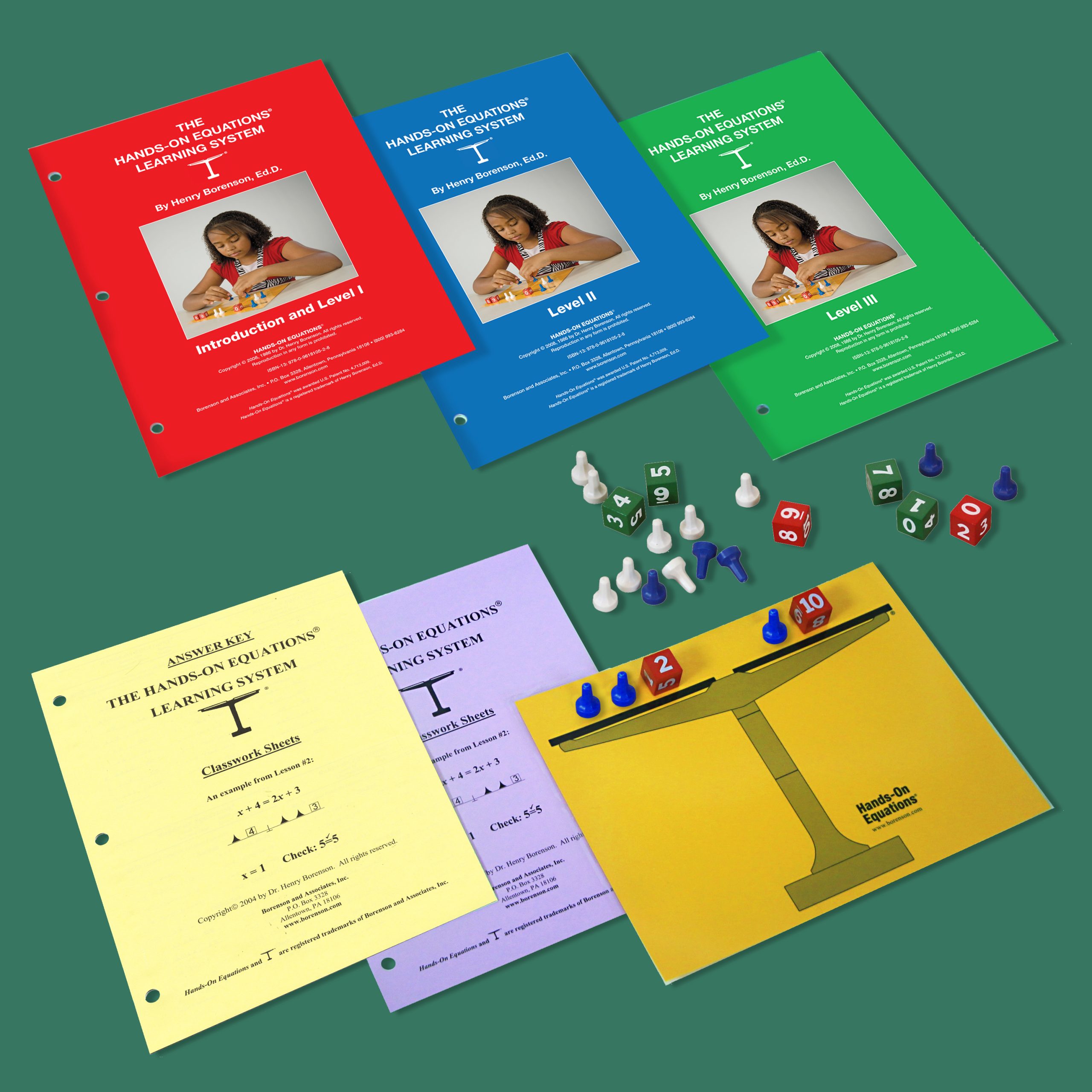
Description
Hands-On Equations
Making Algebra Child's Play!
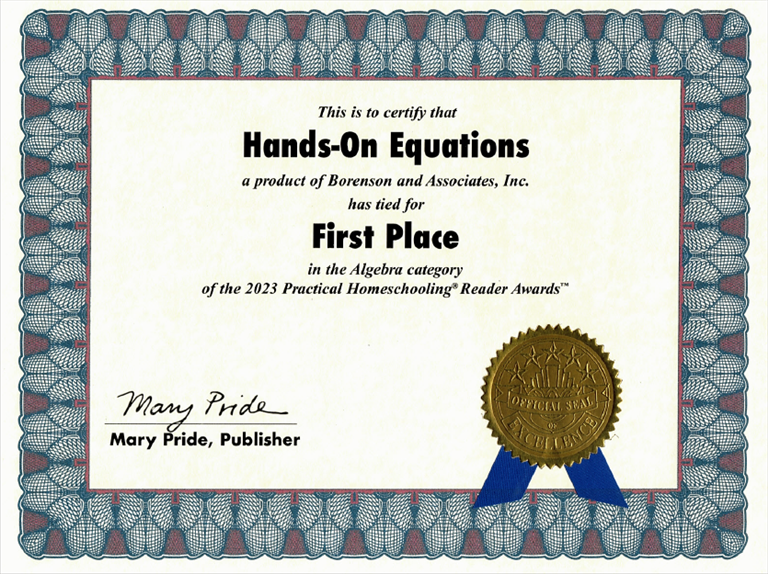
Hands-On Equations is an innovative teaching methodology that was awarded a U.S. patent. More than a million students in the United States have used the program in the classroom since it was first developed in 1986. It has also received enthusiastic reviews from home educators. You may use this program with your child of age 8 and up, or with a gifted child of age 5 or 6. It may also be used with middle school students who are struggling solving equations.
“… great for kinesthetic and visual learners…”– Maria Miller
It is a program that:
- Simplifies the teaching of algebraic concepts
- Makes algebraic concepts accessible to students in grades 3 – 8
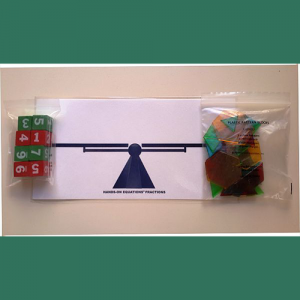
- Uses the game pieces to physically represent and solve algebraic linear equations
- Enables students to enjoy their learning experience
- Promotes greater interest in mathematics
- Enhances student self-esteem
- Enables students to physically represent and solve word problems
- Provides students with a solid foundation for later algebraic learning
- Does not require any algebraic prerequisites
“With this method, anyone, including myself, can be taught algebra without frustration.”
Old Schoolhouse Product Review of Hands-On Equations by Debra Cogburn
Level 1: Lessons 1-7 Red Booklet
Students use the red cubes and blue pawns to set up and solve equations such as:
4x + 3 = 3x + 9 and 2(2x + 1) = 3x + 10.
Level 2: Lessons 8-16 Blue Booklet
Students use the red cubes, blue pawns, and white pawns to set up and solve equations such as:
2x = star + 6 and 2x – star + 2 = x + 10.
Note: Star, written as x, is a new mathematical notation developed by Dr. Borenson for the opposite of x. It is a more compact symbol than the traditional notation, (-x). See note following the video below.
Once students have learned the algebraic concepts using the star notation and the white pawn, they are then ready to transfer their learning and make sense of examples such as 2x + (-x) + 3 = 2(-x) + 12 and 2x – (-x) = 15.
Helen –
Helping kids understand the concept of balancing the algebraic equations.
Regina Walther –
Truly does make algebra child’s play. Designed to start at 3rd or 4th grade, but I use this with jr hi who are struggling to grasp algebraic concepts.
KB –
I first ran across this instructional material as a 4th grade classroom teacher, and really loved using it with my students. Solid pre-algebra materials for the elementary crows are less common, and I was excited to see it sold individually to use at home with my own child. It is a wonderful way to move from concrete manipulation of pieces (they look like large chess pieces) and drawings that represent values and variables, into pre-algebra that uses the standard notation. It glides along very nicely into more levels of difficulty. This set is a great value. I would use the 3 books across 4th, 5th, and 6th grade (they step up in complexity). However, you can start earlier and move at your chosen pace. Everything you need included, including “teacher” demo guide. The demo guide is scripted, and makes each lesson very clear, stepped and self-explanatory. The materials store nicely, without taking much state in the ziplock bag provided. Great program!
Megan –
Wonderful for teaching the basics of algebra to young children and kinestetic learners
Reader –
My 10 year old is really enjoying learning algebra. He says it’s actually kind of fun.
Brit –
Hands-On equations is the best tool there is for introducing algebra. I used it roughly 20 years ago in school and now I’m finishing my PhD in a STEM field at a top university. I’m also dyslexic, so algebra might have been much less accesible to me if it weren’t for this product. I’ve talked to other successful STEM students with and without learning disabilities who also remember Hands-On Equations sparking their initial interest in math. This might be a bit gushy for an Amazon review, but this product seriously changes lives.
Laura Mason –
Great for learning about equations
TnByBirth –
This hands on equations program is the best way to teach the concepts of algebra to young children or to those that are struggling with algebra in high school. It is a wonderful concrete way for children to “see” and understand what they are doing to solve equations. I wish I had been taught this way in high school, instead of trying to memorize what the teacher said, and had no idea what I was doing.
Bellarina –
I purchased these sets for 2 homeschooling families as I saw 1st hand, as a teacher, it’s effectiveness with young and older learners in the classroom! You can get nothing better to teach Algebra concepts “hands on”.
Sativa Gabbey –
This is a great product for visual learning children
She Storms –
This is by far my most favorite math curriculum for pre-algebra. My own teachers oh so many years ago had gone to a class in order to teach this method, they had the hands on system and I loved it so much. When I had my own children and found myself homeschooling I knew I had to find this system for them. I am so glad I did. It truly helped my daughter understand the basic concepts. I think the price is good for all the books and pieces. (I ordered on their website) and I also recommend the app they have for it, though I think being hands on at first is best!
Jane Maupin –
I ordered and used in Gifted program years ago. Now am using in a one on one with my grandson (9years old). Wish I could afford a few more sets to use in school when I volunteer.
Casey –
Perfect for enrichment elementary students or for students that are having difficulty with pre algebra.
Elizabeth S. Schairer –
Outstanding! It focuses on concepts and understanding them rather than memorizing steps.
beth –
Fantastic product for students in need of multisensory instruction.
amy –
This is a great method for teaching algebra to younger kids. My 9, 12, and 13 year old are really grasping the algebraic concepts and I cannot be more thrilled! When it’s time to pull out the “scale” and blocks they light up. It’s nice to see them looking forward to math lessons for a change. I highly recommend Hands On Equations for teaching how to solve linear equations.
R Walters –
I purchased this item through Amazon a year or two ago, and when I received it, I was surprised to open a Tyvek envelope with manipulatives, a couple of very thin workbooks, a gob of promotional inserts, and an instructional DVD with scant instruction demonstrated by children. There was no comprehensive instruction as to which materials to use to present a lesson, so I had to sort through the gobs of promotional papers, advertisements, and articles to find the first thin workbook. I had to watch the DVD a couple of times to get the gist of what the game pieces represented and how they were to be used. Unless I’m mistaken, I spent about $85 for it, which is way more than I have spent on other complete math curriculum with workbooks and DVD. The method is very good, and Dr. Borensen should be proud of himself for thinking of it, but the average consumer will consider herself gouged when she receives it because the package stops short of being thorough. Here is what I think I should have received that would make it worth the price I was charged:
1. A binder with sections titled: Promotional Matter and Advertisements, Articles, Workbooks, and Answer Key.
2. A teachers manual outlining lessons, including which materials will be required to present a lesson.
3. A DVD with more thorough presentation; multiple demonstrations of equations for each lesson. (See Math-U-See’s demo DVD.)
4. LOTS more algebra equations to practice on for each level; either access to a website where teachers can print off worksheets, or workbooks with many more practice equations.
5. A 3-D scale rather than the laminated drawing. (C’mon, it can’t be that expensive.)
6. Permission to copy workbook pages for more than one student.
When I ordered this product, I couldn’t tell exactly what I was going to receive, so I crossed my fingers and hoped for the best. I wasn’t very happy when I got it. I discovered I was supposed to have bought a separate kit for a second student.
I’ve since purchased the same kit (to honor copyright) from Rainbow Resources, and to my consternation received the identical maelstrom of papers with lack of direction. The only improvement was that the DVD does have Dr. Borenson demonstrating the method, and from the DVD I was able to figure out which of the three workbooks I needed to start with. At least there is now an app that for IPad or IPhone that allows for more practice, but you have to spend $5 to get it. For $85, one would think that the app would be included in the package.
Gardener –
My eight year old loves this program. He likes it so much that he doesn’t even notice that he is working with addition while he solves the algebraic equations.
Jessica –
My students love this product. It is a great tool for algebra as it is very visual. Also, the manual is great.
Belinda –
I’m writing this review of Hands On Equations because I’ve been using it with my kids. The way that the program teaches kids to “play” at math is very satisfying. The lessons are easy and my kids were always begging for more. However after finishing “Level 3,” I found that I needed the program to go a little farther than it did. Let me explain. Hands On Equations starts kids out by simplifying everything to addition. Then it adds subtraction and finally negative variables. What it doesn’t do is teach kids how to balance an equation if it requires multiplication of a number such as 2/2 or division (such as when the inverse of a number 1/2 is multiplied to both sides to cancel out a number an isolate “x”). This became apparent when we moved from Hands On Equations to Ed Zaccaro’s Real World Algebra. Chapter one in Zaccaro’s book discusses how words are translated into algebraic equations. Chapter two is basically solving algebraic equations which covers in one chapter all of the lessons in Hands On Equations. The problem is that all levels of difficulty are mixed together and it becomes obvious that my kids were unprepared to handle the most difficult equations. For example: The question is posed, “Write an algebraic expression for the diameter of a circle with a circumference of n.” In order to write the equation you have to start with Circumference = pi times diameter. To balance it, you have to divide both sides by pi. In Hands On Equations division is never used on both sides of the equation and certainly not 1 over pi. My kids were a bit mystified. I explained that it was the same thing as what they knew — doing the same thing to both sides of the equation but they wanted more clarification. How 2/2 is equal to 1 and can be multiplied to both sides is not covered in Hands On Equations but should be. Fractions and irrational numbers are used regularly in algebra. As a parent, I found that I had to make up the difference between where Hands On Equations left off and where the next level of math picked up.
chicken –
I used this product when I was home tutoring a student in basic math. It was a great product that showed visually an abstract concept. Great purchase. One thing I didn’t realize until after I purchased it was that the student booklet with practice pages can’t be photocopied without buying an entire classroom set of the pieces.
Patricia Ross –
This makes algebraic concepts so easy and obvious that anyone can get it! Wish it went farther, but once thru this course more advanced algebra is much easier because the foundation has been laid.
Karen A. Krall –
I highly reccommend this product. I homeschool my boys. We use Saxon Math, but they get bored of doing it all the time. I also have many other math manipulatives that we supplement Saxon with. This one is my boys’ favorite!! They love it! They are only 9 years old, and the equations they are able to easily solve using the methods in this program are amazing. It gives kids a great beginning foundation for the algebra they will be introduced to later in school.